Bearded Dragon Care Guide: Brutally Honest Setup & Costs
Heads up: This post contains affiliate links. If you buy something through them, I earn a small commission at no extra cost to you. It keeps the lights on and the kibble bowl full. Read the full boring legal stuff here.

🦎 What Nobody Tells You About Bearded Dragons
- That $40 bearded dragon at the pet store will cost you $400-600 in equipment before you even bring it home — and if you cheap out on the setup, you'll spend that money on vet bills instead when your dragon develops metabolic bone disease six months later.
- Bearded dragons are not "easy" pets — they require daily feeding, daily enclosure spot-cleaning, proper UVB lighting (replaced every 12 months), temperatures monitored multiple times per day, and live insects you have to gut-load and dust yourself.
- Most bearded dragons sold in pet stores are already sick — parasites, respiratory infections, and early-stage MBD are standard issue, and you won't notice until weeks after purchase when the symptoms become obvious.
- The $50 "bearded dragon starter kit" will kill your dragon — undersized tanks, weak UVB bulbs, analog thermometers, and calcium sand substrate are designed to extract your money, not keep reptiles alive.
- Bearded dragons live 10-15 years if you do everything right — which means a decade of buying insects, replacing bulbs, cleaning enclosures, and paying for vet visits whenever something goes wrong, because things will go wrong.
This is not the glossy care guide that makes bearded dragon ownership sound fun and easy. This is what actually happens when you bring one home.
Bearded Dragon Care: The Brutally Honest Beginner's Guide
Bearded dragons are marketed as beginner reptiles.
They're not.
They're marketed that way because they tolerate handling, don't bite often, and survive long enough in terrible conditions that pet stores can sell them to people who have no idea what they're doing without the dragon dying in the first week.
That doesn't make them easy. It makes them durable enough to suffer slowly instead of dying fast.
If you're reading this before buying a bearded dragon, good.
You're about to find out what actually happens when you own one, the equipment costs, the daily maintenance, the vet bills, the insects that smell like death, and the constant vigilance required to keep a desert lizard alive in a glass box in your living room.
If you're reading this after buying a bearded dragon, you've probably already discovered that the pet store lied about half of what you were told.
This guide will fix the rest.
← Back to complete reptile care guide
What Bearded Dragon Ownership Actually Costs
Pet stores sell bearded dragons for $40-60 and push a "starter kit" for another $50-80.
That's $100-140 total, which sounds affordable.
Here's what a proper bearded dragon setup actually costs:
- 40-gallon tank (minimum for juveniles): $100-150
- 75-120 gallon tank (adult requirement): $200-400
- T5 HO UVB fixture + bulb: $80-120
- Basking bulb + fixture: $30-50
- Digital thermometers (2): $20-30
- Infrared temp gun: $20-30
- Substrate (tile, paper, or mat): $20-50
- Basking platform + decor: $30-60
- Food/water dishes: $15-25
- Dimming thermostat (optional but recommended): $50-80
Initial setup cost: $565-995.
That's before you buy the dragon.
And before you factor in ongoing costs:
- Live insects: $20-40 per month
- Fresh vegetables: $10-20 per month
- Calcium supplements: $10-15 per month
- UVB bulb replacement: $35-50 every 12 months
- Basking bulb replacement: $10-15 every 6-9 months
- Vet visits (annual checkup + fecal exam): $100-200 per year
Annual ongoing cost: $550-850.
If you can't afford that, don't buy a bearded dragon.
Cheaping out on equipment kills them, and treating the resulting health problems costs more than proper setup would have.
Enclosure Setup: Size, Heating, and Why Your Tank Is Too Small
Tank Size: Stop Listening to Pet Store Employees
Pet stores sell 20-gallon tanks as "perfect for bearded dragons."
They're not perfect. They're profitable.
Minimum enclosure sizes:
- Hatchlings (0-6 months): 40-gallon breeder tank (36" x 18" x 18")
- Juveniles (6-12 months): 75-gallon tank (48" x 18" x 21")
- Adults (12+ months): 120-gallon tank (48" x 24" x 24") or larger
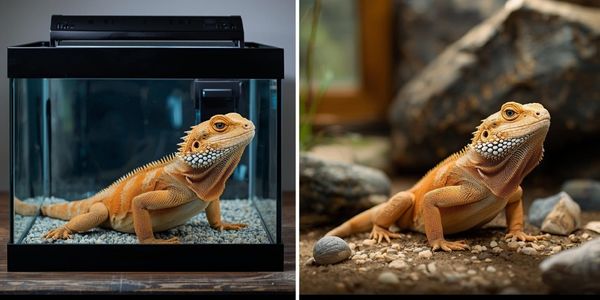
A 20-gallon tank doesn't give an adult bearded dragon (18-24 inches long) enough space to move, thermoregulate, or behave naturally.
It's a display box that looks good in a pet store but causes chronic stress in the animal living in it.
If you can't fit a 120-gallon tank in your home, don't buy a bearded dragon.
Buy a leopard gecko instead. They're actually small.
Heating: Two Sources, Not One
Bearded dragons are desert reptiles from Australia.
They need a basking spot at 100-110°F and a cool side at 75-85°F.
You need two heat sources to achieve this:
- Daytime basking heat: 75-100 watt halogen basking bulb
- Nighttime ambient heat (if room drops below 65°F): Ceramic heat emitter or deep heat projector
One heat lamp doesn't create a proper thermal gradient.
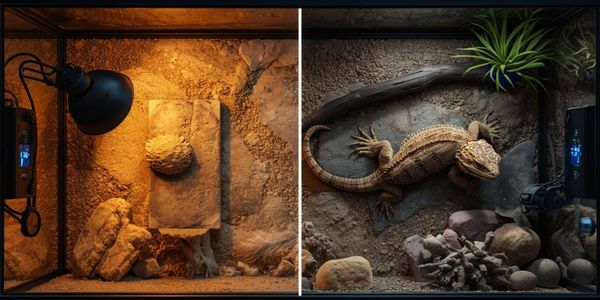
It creates a hot spot directly under the bulb and leaves the rest of the enclosure too cold.
The Zoo Med Basking Combo Pack includes a porcelain dome fixture and a 100-watt basking bulb that actually produces focused heat instead of the weak diffused warmth you get from cheap plastic domes that warp within three months and become fire hazards.
UVB: The Thing That Prevents Metabolic Bone Disease
UVB lighting is not optional.
Bearded dragons need UVB to synthesize vitamin D3, which allows calcium absorption.
Without UVB, your dragon's bones slowly soften, its jaw swells, its legs bend, and it dies.
This is called metabolic bone disease, and it's the #1 killer of captive bearded dragons because people skip UVB or use expired bulbs.
Correct UVB setup:
- T5 HO 10.0 or 12.0 UVB bulb (not compact coil, not T8)
- 24-36 inch fixture mounted inside the enclosure or on screen top with no glass barrier
- Bulb positioned 12-18 inches from basking platform
- Replaced every 12 months even if it still glows (UVB output degrades before visible light does)
The Zoo Med ReptiSun 10.0 T5 HO UVB Bulb and matching fixture is the gold standard, it delivers proper UVB for 12 months, covers the full length of standard tanks, and produces strong enough output that you can mount it 12-18 inches away instead of forcing your dragon to sit 6 inches from a weak T8 bulb that stops working after 6 months.
Substrate: Stop Using Sand
Pet stores sell "calcium sand" marketed as safe for bearded dragons.
It's not.
Bearded dragons eat substrate while catching insects, and ingested sand causes impaction, a blockage in the digestive tract that requires surgery or kills the animal.
"Calcium sand" doesn't dissolve. It clumps. It's worse than regular sand.
Safe substrate options:
- Ceramic tile: Easy to clean, holds heat, looks natural, zero impaction risk
- Non-adhesive shelf liner: Cheap, replaceable, easy to clean
- Reptile carpet: Reusable but harbors bacteria if not washed weekly
- Paper towels: Ugly but functional and disposable
Avoid:
- Sand (calcium or regular)
- Walnut shell
- Wood chips
- Anything loose that can be accidentally eaten
Temperature Monitoring: Stick-On Thermometers Are Useless
Those adhesive thermometers pet stores include in starter kits measure air temperature at the glass, not surface temperature where your dragon actually sits.
They're consistently off by 10-15°F and give you false readings that make you think everything is fine while your dragon slowly freezes or overheats.
You need:
- Digital probe thermometer on basking spot (measures surface temp)
- Digital probe thermometer on cool side (measures ambient temp)
- Infrared temp gun (spot-checks temps throughout the day)
The Etekcity Infrared Thermometer Gun lets you point-and-click to measure basking platform temps, floor temps, and hide temps instantly instead of guessing based on cheap analog gauges that haven't worked correctly since 1987.
Diet: It's More Complicated Than "Feed It Crickets"
Age-Based Diet Requirements
Bearded dragon nutritional needs change as they grow.
Hatchlings (0-6 months):
- 80% insects, 20% vegetables
- Feed insects 2-3 times per day
- Offer as many insects as they'll eat in 10-15 minutes
Juveniles (6-12 months):
- 50% insects, 50% vegetables
- Feed insects once daily
- Offer vegetables daily (most will ignore them, offer anyway)
Adults (12+ months):
- 20% insects, 80% vegetables
- Feed insects 3-4 times per week
- Offer fresh vegetables daily
Most people overfeed insects and underfeed vegetables, producing obese adult dragons with fatty liver disease.

Feeder Insects: Gut-Load and Dust Everything
Pet store crickets are nutritionally worthless without preparation.
You need to gut-load (feed the insects nutritious food 24-48 hours before offering them) and calcium dust (coat them in supplement powder immediately before feeding).
Good feeder insects:
- Dubia roaches (best option, don't smell, don't die, better nutrition than crickets)
- Black soldier fly larvae (naturally high calcium)
- Crickets (cheap but require gut-loading and smell terrible)
- Superworms (occasional treat, not staple)
Avoid:
- Mealworms for juveniles (hard exoskeleton, impaction risk)
- Waxworms except as rare treats (too much fat, addictive)
- Wild-caught insects (pesticide and parasite risk)
The Rep-Cal Calcium with D3 is ultrafine powder that actually sticks to insects instead of falling off before your dragon catches them, and the D3 content is properly dosed for dragons with UVB lighting so you're supplementing correctly instead of guessing and causing either deficiency or toxicity.
Vegetables: What to Feed and What Kills Them
Staple vegetables (feed daily):
- Collard greens
- Mustard greens
- Turnip greens
- Endive
- Escarole
- Butternut squash
- Acorn squash
- Bell peppers
Occasional vegetables (1-2 times per week):
- Carrots
- Green beans
- Parsnips
- Okra
Avoid completely:
- Spinach: High oxalates block calcium absorption
- Iceberg lettuce: Zero nutritional value
- Avocado: Toxic
- Rhubarb: Toxic
- Onions/garlic: Toxic
Chop vegetables into bite-sized pieces (no larger than the space between your dragon's eyes).
Most juveniles ignore vegetables, offer them anyway to establish the routine.
Hydration: Water Dishes and Baths
Bearded dragons rarely drink from water dishes.
They get most hydration from vegetables and from licking water droplets off surfaces.
Provide a shallow water dish anyway (refreshed daily), but don't expect to see your dragon drinking from it.
Weekly soaks: Place your dragon in a shallow tub of lukewarm water (chest-deep, not deep enough to swim) for 10-15 minutes once per week.
This aids hydration, helps with shedding, and stimulates bowel movements.
Never leave a dragon unattended in water, they can drown.
Health Problems: What Actually Goes Wrong
Metabolic Bone Disease (MBD)
Caused by: Lack of UVB, insufficient calcium, improper diet.
Symptoms:
- Soft or rubbery jaw
- Bowed or bent legs
- Swollen limbs
- Tremors or twitching
- Difficulty walking
- Seizures (advanced cases)
MBD is 100% preventable with proper UVB and calcium supplementation.
Once bone deformities appear, the damage is permanent.
Treatment involves aggressive calcium supplementation and UVB correction, but the dragon's skeleton never fully recovers.
Respiratory Infections
Caused by: Low temperatures, high humidity, poor ventilation, stress.
Symptoms:
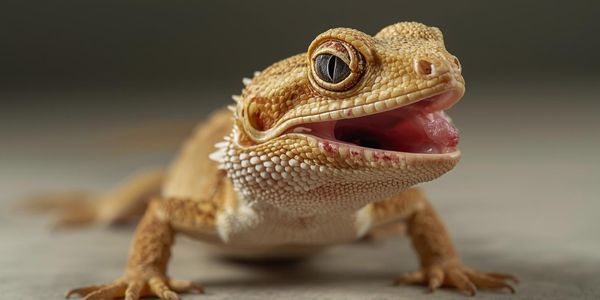
- Open-mouth breathing
- Mucus around nostrils or mouth
- Wheezing or clicking sounds when breathing
- Lethargy
- Loss of appetite
Respiratory infections require antibiotics from a reptile vet.
They don't resolve on their own, and delaying treatment kills the dragon.
Parasites
Most bearded dragons sold in pet stores have parasites, pinworms, coccidia, or both.
Symptoms:
- Diarrhea or runny stool
- Weight loss despite eating
- Lethargy
- Loss of appetite
Get a fecal exam from a reptile vet within the first month of ownership.
Parasite treatment is simple if caught early, fatal if ignored.
Impaction
Caused by: Eating substrate (sand, wood chips), eating insects that are too large, dehydration, low temperatures.
Symptoms:
- No bowel movements for 7+ days
- Bloated abdomen
- Lethargy
- Loss of appetite
- Dragging back legs
Impaction requires veterinary intervention, warm baths and gentle massage sometimes work for mild cases, but severe impaction requires surgery.
Behavior: What's Normal and What's a Problem
Basking All Day: Normal
Bearded dragons sit motionless under their basking light for hours.
This is not laziness. This is thermoregulation.
If your dragon is active, alert, eating normally, and just spends most of its time basking, that's normal.
Glass Surfing: Stress
If your dragon frantically scratches at the glass walls, pacing back and forth, it's stressed.
Common causes:
- Tank too small
- Seeing its own reflection (cover glass with background)
- Not enough hides or cover
- Incorrect temperatures
- Boredom (adults especially)
Beard Puffing and Darkening: Threat Display
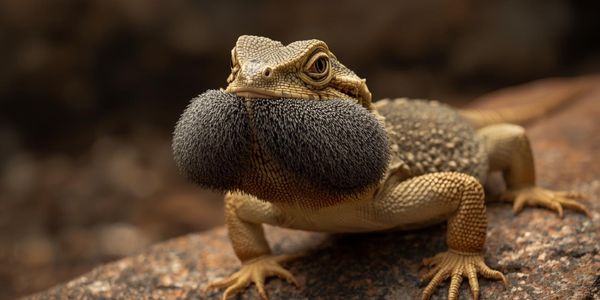
When threatened, bearded dragons puff out their beard and darken its color to appear larger.
This is normal territorial or defensive behavior.
If it happens constantly when you approach, your dragon hasn't acclimated to you yet.
Give it time and handle it gently and consistently.
Arm Waving: Submission
Bearded dragons wave one front leg in a slow circular motion as a submissive gesture.
Juveniles do this more often than adults.
It's not a problem, it's social signaling.
Brumation: Reptile Hibernation
Adult bearded dragons often brumate (hibernate) during winter months.
Brumation behavior:
- Reduced appetite or complete refusal to eat
- Sleeping for days or weeks at a time
- Hiding more than usual
- Less activity
Brumation is normal and natural, but first-time owners often panic and think their dragon is dying.
If your dragon shows brumation behavior in winter (November-February in Northern Hemisphere) and is otherwise healthy (no weight loss, no visible illness), leave it alone.
Reduce feeding frequency, maintain lighting schedule, and let it sleep.
If you're unsure whether it's brumation or illness, see a reptile vet.
Common Beginner Mistakes That Kill Bearded Dragons
1. Using the Pet Store Starter Kit
Those kits contain undersized tanks, weak UVB bulbs, analog thermometers, and sand substrate.
Everything in them is wrong.
Ignore the kit. Buy proper equipment individually.
2. Cohabitating Multiple Dragons
Bearded dragons are solitary and territorial.
Housing multiple dragons together causes fighting, stress, injury, and death.
One dragon per enclosure. No exceptions.
3. Handling a Sick Dragon
If your dragon is lethargic, not eating, or showing signs of illness, stop handling it.
Stress worsens illness, and handling a sick reptile stresses it.
See a vet, not Instagram.
4. Overfeeding Insects, Underfeeding Vegetables
Adult dragons are primarily herbivorous.
Feeding insects daily produces obese dragons with fatty liver disease.
Stick to the 80% vegetables, 20% insects ratio for adults [web:168].
5. Skipping Vet Visits
Bearded dragons need annual checkups and fecal exams, even when they appear healthy.
Parasites, early-stage MBD, and organ issues aren't visible until they're advanced.
Find a reptile vet before you need one.
Final Thoughts: Are You Actually Ready for This?
Bearded dragons are not low-maintenance pets.
They're not "easier than a dog" or "perfect for kids."
They require daily feeding, daily cleaning, temperature monitoring, UVB replacement, insect gut-loading, calcium dusting, weekly baths, and annual vet visits.
They live 10-15 years if you do everything correctly, which means over a decade of sustained effort and expense.
If you're ready for that, bearded dragons are rewarding animals, they recognize their owners, tolerate handling, have distinct personalities, and thrive under proper care.
If you're not ready, don't buy one because it "looks cool" or because a pet store employee said it's easy.
Get a stuffed animal instead. It won't develop metabolic bone disease when you forget to replace the UVB bulb.
🐾 Frequently Asked Questions
Q How much does it actually cost to set up a bearded dragon enclosure properly?
$600-1,000 for the initial setup, not the $100-150 pet stores tell you. You need a 40-gallon tank minimum for juveniles ($100-150), a 120-gallon for adults ($200-400), a T5 HO UVB fixture and bulb ($80-120), basking bulb and fixture ($30-50), digital thermometers ($20-30), an infrared temp gun ($20-30), safe substrate ($20-50), decor and basking platforms ($30-60), and food dishes ($15-25). Then there's ongoing costs: $20-40 monthly for insects, $10-20 for vegetables, $10-15 for calcium supplements, plus replacing UVB bulbs every 12 months ($35-50) and basking bulbs every 6-9 months ($10-15). Annual vet visits add another $100-200. If you can't afford proper equipment upfront, don't buy a bearded dragon, cheaping out causes metabolic bone disease and costs more in vet bills than correct setup would have.
Q Can I keep a bearded dragon in a 20-gallon tank?
No. Pet stores sell 20-gallon tanks as "perfect for bearded dragons" because they're profitable, not because they work. Adult bearded dragons grow 18-24 inches long and need a minimum 120-gallon enclosure (48" x 24" x 24") to move, thermoregulate, and behave naturally. Even juveniles need at least a 40-gallon tank. A 20-gallon tank doesn't provide enough space to create a proper temperature gradient (hot basking side at 100-110°F, cool side at 75-85°F), forces the dragon to sit in either too-hot or too-cold zones, and causes chronic stress that weakens the immune system and shortens lifespan. If you can't fit a 120-gallon tank in your home, don't get a bearded dragon, get a leopard gecko instead, which actually stays small enough for smaller enclosures.
Q Do bearded dragons really need UVB lighting or can I just use calcium supplements?
They need UVB. Calcium supplements without UVB are useless because bearded dragons can't absorb dietary calcium without vitamin D3, and they can't produce D3 without UVB exposure. Feeding calcium-dusted insects to a dragon without proper UVB just coats the food in chalk powder that passes through unabsorbed while the dragon's bones slowly dissolve from the inside—that's metabolic bone disease, and it's 100% preventable with correct lighting. You need a T5 HO 10.0 UVB bulb in a proper fixture, mounted 12-18 inches from the basking spot, replaced every 12 months even if it still glows. Oral D3 supplements exist but don't replace UVB, they're inconsistent, easy to overdose, and don't allow natural self-regulation like UV exposure does. If you skip UVB, your dragon will develop MBD, and once bone deformities appear, the damage is permanent.
Q Why won't my bearded dragon eat vegetables?
Because it's a juvenile and juveniles are primarily insectivorous (80% insects, 20% vegetables). They instinctively prioritize high-protein food for growth and often ignore vegetables completely until they're 10-12 months old. Offer vegetables daily anyway to establish the routine, chop them into bite-sized pieces, place them in a visible dish, and let your dragon ignore them. As it matures, its dietary needs shift to 80% vegetables and 20% insects, and it will eventually start eating greens. If your adult dragon (12+ months) still refuses vegetables, you've been overfeeding insects and created a picky eater addicted to high-protein food. Reduce insect frequency to 3-4 times per week maximum, offer fresh vegetables daily, and don't cave, a healthy dragon won't starve itself, it'll eventually eat the greens when hungry enough.
Q Is it normal for my bearded dragon to sleep all day and not move?
Depends. If it's basking under the heat lamp looking alert with its eyes open, that's normal thermoregulation—bearded dragons sit motionless for hours absorbing heat, and that's what they're supposed to do. If it's sleeping excessively (eyes closed, unresponsive, hiding constantly), not eating, or lethargic even when warm, something's wrong. Check temperatures first: basking spot should be 100-110°F measured with a temp gun, not a stick-on thermometer that's always wrong. If temps are correct and the dragon is still lethargic, check for illness symptoms (mucus, labored breathing, abnormal stool, weight loss). Adult dragons also brumate (hibernate) during winter months, sleeping for days or weeks with reduced appetite, this is normal if it happens November-February and the dragon is otherwise healthy. If you're unsure whether it's brumation, improper temps, or illness, see a reptile vet instead of asking Reddit.

📖 Related Articles
7 Ways to Socialize a Guinea Pig: The 2026 Guide
💬 Comments (0)
No comments yet. Be the first to share your thoughts! 👇
✍️ Leave a Reply