Feeder Insects for Reptiles: Gut-Loading & Dusting Guide
Heads up: This post contains affiliate links. If you buy something through them, I earn a small commission at no extra cost to you. It keeps the lights on and the kibble bowl full. Read the full boring legal stuff here.

🦗 What You Need to Know About Feeder Insects
- Pet store crickets are nutritionally worthless — they're raised on cardboard and grain scraps, then shipped in crowded containers where half of them die and the survivors eat the corpses before you buy them.
- Gut-loading is not optional — feeding insects nutritious food 24-48 hours before offering them to your reptile is the only way those insects deliver actual nutrition instead of crunchy air pockets with legs.
- Calcium dusting without D3 is useless — unless your reptile has perfect UVB exposure, it can't metabolize plain calcium, so you're just coating insects in chalk dust that does nothing.
- Crickets are the worst feeder insect commonly available — they smell terrible, die constantly, carry parasites, bite sleeping reptiles, and have a worse calcium-to-phosphorus ratio than almost any other option.
- Most reptiles eating "plenty of insects" are slowly starving — volume doesn't equal nutrition, and a bearded dragon eating 30 un-gutloaded, un-dusted crickets per day is developing nutritional deficiencies just as fast as one eating nothing.
This guide explains how to properly prepare feeder insects, which insects are actually worth feeding, and why the "just toss some crickets in there" approach kills more reptiles than most people realize.
Feeder Insects: Gut-Loading, Dusting, and Why Your Crickets Are Empty Calories
Most reptile keepers think feeding insects is simple.
Buy crickets, dump them in the enclosure, watch the lizard eat them, repeat.
That approach produces reptiles with metabolic bone disease, vitamin A deficiency, stunted growth, immune dysfunction, and early death.
Because the insects you're feeding are nutritionally empty.
A cricket fresh from a pet store has been raised on the cheapest grain-based diet possible, shipped in overcrowded containers with minimal food, and stored in the back room eating cardboard and dead crickets for days before you bought it.
Its gut is either empty or full of nutritionally useless filler.
When your reptile eats that cricket, it's getting chitin (indigestible exoskeleton), a tiny amount of protein, almost no calcium, excess phosphorus, and whatever random garbage was in the cricket's digestive tract.
That's not a meal. That's crunchy fiber with a side of imbalanced minerals.
This article explains how to properly prepare feeder insects through gut-loading and dusting, which insects are worth feeding, and why most "insect-eating reptiles" are chronically malnourished even when they're eating daily.
← Back to complete reptile care guide
Why Feeder Insects Are Nutritionally Worthless Without Preparation
Feeder insects are only as nutritious as what they've recently eaten.
That's the entire concept.
A cricket raised on high-calcium greens and quality protein becomes a calcium-rich, protein-dense food item.
A cricket raised on cardboard and grain scraps becomes a hollow shell with terrible mineral ratios and almost no usable nutrition.
Pet stores and insect suppliers don't gut-load feeders before selling them.
They feed them the cheapest maintenance diet that keeps them alive long enough to sell, which is usually wheat bran, oats, or literal cardboard.
When you buy crickets and feed them to your reptile within 24 hours, you're feeding your reptile wheat bran and cardboard by proxy.
The Calcium-to-Phosphorus Problem
Reptiles need a calcium-to-phosphorus ratio of roughly 2:1 in their diet.
Most feeder insects have the opposite ratio, more phosphorus than calcium.
Crickets: 1:9 calcium-to-phosphorus ratio (nine times more phosphorus than calcium).
Mealworms: 1:7 ratio.
Superworms: 1:18 ratio.
Phosphorus blocks calcium absorption in the digestive tract.
So even if your reptile is eating calcium-dusted insects, the excess phosphorus from the insect's body prevents proper calcium uptake, and you end up with the same metabolic bone disease you were trying to prevent.
Gut-loading and dusting corrects this.
Gut-loading fills the insect's digestive tract with high-calcium food.
Dusting coats the outside with supplemental calcium.
Together, they shift the ratio back toward 2:1 where it needs to be.
Gut-Loading: How to Turn Garbage Insects Into Actual Food
Gut-loading is the process of feeding your feeder insects a nutritious diet 24-48 hours before offering them to your reptile.
The insect's digestive tract fills with that high-quality food, and when your reptile eats the insect, it gets the nutrition from both the insect's body and the gut contents.
What to Gut-Load With
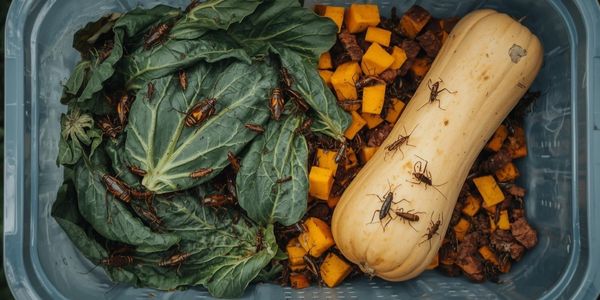
High-calcium greens are the foundation:
- Collard greens
- Mustard greens
- Turnip greens
- Dandelion greens
- Endive
Add variety with:
- Butternut squash (high in vitamin A)
- Sweet potato (beta-carotene)
- Carrots (vitamin A)
- Bell peppers (vitamin C)
Avoid:
- Iceberg lettuce (zero nutrition)
- Spinach (contains oxalates that block calcium absorption)
- Cabbage (goitrogens that interfere with thyroid function)
Commercial gut-load products work if you're lazy or don't have fresh greens available.
Repashy Superload, Fluker's High-Calcium Cricket Diet, and similar products are formulated with correct mineral ratios and vitamins.
The Repashy Superload is one of the few commercial gut-load formulas that actually works,it's a gel-based food that hydrates insects while loading them with calcium, vitamins, and protein, so you're not relying on wilted greens that half your crickets ignore.
How Long to Gut-Load
Minimum: 24 hours.
Optimal: 48 hours.
Insects need time to eat, digest, and fill their gut with the new food.
Feeding them high-calcium greens for 2 hours before tossing them to your reptile does almost nothing—the food hasn't been digested yet, and the insect's gut is still full of whatever garbage it ate before you bought it.
Set up a separate container for gut-loading.
Transfer feeders from their storage bin to the gut-loading container 24-48 hours before feeding time.
Provide fresh greens, remove uneaten food after 12 hours, replace with fresh food.
Hydration Matters
Dehydrated insects are less nutritious and harder for reptiles to digest.
Provide moisture through water crystals, fresh vegetables (not water bowls, crickets drown), or a damp paper towel.
Commercial cricket quenchers like Fluker's Cricket Quencher prevent drowning while keeping insects hydrated, and hydrated insects retain more nutrients and live longer in your gut-loading container instead of dying overnight and getting cannibalized by the survivors.
Calcium Dusting: The Second Half of Proper Supplementation
Gut-loading fills the insect's digestive tract with nutrition.
Dusting coats the outside with supplemental calcium and vitamins.
Both are necessary.
Calcium With or Without D3?
This depends on your UVB setup.
If you have proper UVB lighting: Use calcium without D3 for daily dusting, and calcium with D3 once or twice per week.
If you don't have UVB (which you should): Use calcium with D3 at every feeding.
D3 toxicity is possible if you over-supplement while also providing strong UVB, but it's rare.
D3 deficiency is common and kills reptiles constantly.
When in doubt, use calcium with D3.
The Rep-Cal Calcium with D3 is the industry standard for a reason, it's ultrafine powder that actually sticks to insects instead of falling off before your reptile catches them, and the D3 content is properly dosed so you're not guessing whether you're under-supplementing or poisoning your lizard.
How to Dust Properly
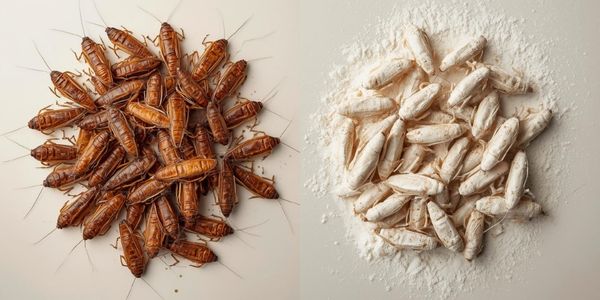
Put insects in a plastic bag or container with a small amount of calcium powder.
Shake gently until insects are lightly coated.
"Lightly coated" means you can still see the insect's body color through a thin layer of powder.
If the insect looks like it was dipped in flour, you've used too much, and most of it will fall off before your reptile eats it.
Dust immediately before feeding.
Calcium powder falls off insects within 10-15 minutes, so dusting them an hour before feeding time wastes half the supplement.
Multivitamin Dusting
Calcium handles bone health.
Multivitamins handle everything else, vitamin A, vitamin E, B vitamins, trace minerals.
Dust with a reptile multivitamin once or twice per week, separate from calcium dustings.
Do not use multivitamin powder at every feeding, vitamin A toxicity is possible with over-supplementation.
The Repashy Calcium Plus is an all-in-one powder that combines calcium, D3, and vitamins in balanced ratios, so if you can't be bothered to track separate dusting schedules, you can use this at every feeding and cover all your bases without overdosing anything.
Feeder Insect Comparison: What's Actually Worth Feeding
Not all feeder insects are equal.
Some are nutritionally dense, easy to keep, and well-tolerated by most reptiles.
Others are garbage that only persist because pet stores stock them.

1. Crickets: The Worst Option Everyone Uses
Pros: Cheap, widely available, high movement triggers feeding response.
Cons:
- Terrible calcium-to-phosphorus ratio (1:9)
- Smell awful, especially when they die (and they die constantly)
- Cannibalistic—dead crickets get eaten by live ones, spreading bacteria
- Bite sleeping reptiles, causing stress and wounds
- Noisy (constant chirping from adult males)
- Short lifespan in captivity (1-2 weeks after purchase)
Crickets are fine if you gut-load and dust them properly, but they're objectively the worst commonly available feeder insect.
The only reason people still use them is because pet stores stock them and they're cheap.
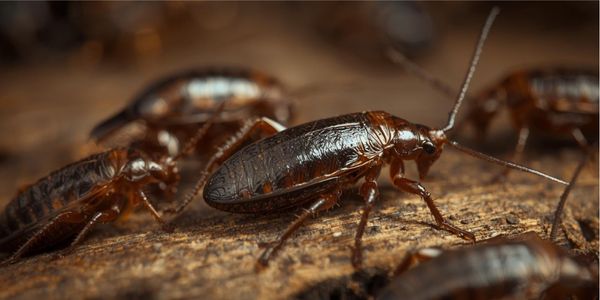
2. Dubia Roaches: The Actual Best Option
Pros:
- Better calcium-to-phosphorus ratio than crickets
- Don't smell, don't chirp, don't bite
- Long lifespan (12+ months for adults)
- Can't climb smooth surfaces, so escapes are rare
- Higher protein content than crickets
Cons:
- Slower movement, some reptiles don't recognize them as food initially
- Illegal in Florida and some other states (classified as invasive species)
- More expensive than crickets
Dubia roaches are what serious keepers use after they get tired of dealing with crickets.
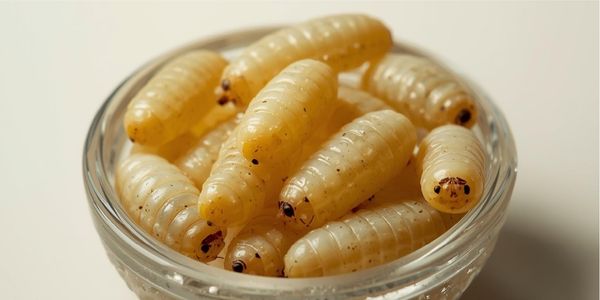
3. Black Soldier Fly Larvae (BSFL): The Calcium Powerhouse
Pros:
- Natural calcium-to-phosphorus ratio is nearly perfect (1.5:1)
- Don't require gut-loading (naturally nutritious)
- Long shelf life (weeks in refrigerator)
- Don't smell, don't bite, don't escape
Cons:
- High fat content, not suitable as a staple for all species
- Low movement, picky eaters may ignore them
BSFL are excellent as part of a varied diet, especially for species prone to calcium deficiency.
The Fluker Black Soldier Fly Larvae come pre-packaged in quantities perfect for weekly feeding, they're already calcium-loaded naturally so you're not dependent on dusting, and they keep in the fridge for weeks without dying or turning into flies.
4. Mealworms: The Mediocre Standby
Pros:
- Long shelf life (months in refrigerator)
- Easy to store and handle
- Inexpensive
Cons:
- High chitin content (hard exoskeleton, difficult to digest)
- Poor calcium-to-phosphorus ratio (1:7)
- Low moisture content
- Can cause impaction if fed as a staple
Mealworms are fine as an occasional treat but shouldn't be a dietary staple.
5. Superworms: Mealworms But Worse
Pros: Larger than mealworms, higher movement.
Cons:
- Even worse calcium-to-phosphorus ratio than mealworms (1:18)
- High fat content
- Harder exoskeleton than mealworms
- Can bite (strong mandibles)
Superworms are treats, not staple feeders.
They're useful for putting weight on underweight reptiles or enticing picky eaters, but feeding them daily causes nutritional imbalances.
6. Hornworms: The Hydration Bomb
Pros:
- 85% water content, excellent for hydration
- Soft-bodied, easy to digest
- High in calcium (better ratio than most feeders)
Cons:
- Expensive
- Short shelf life (grow rapidly, must be fed before they pupate)
- Very low in protein and fat
Hornworms are great for rehydrating sick or dehydrated reptiles but aren't nutritionally complete for daily feeding.
7. Waxworms: Reptile Candy
Pros: High fat content, irresistible to most reptiles.
Cons:
- Terrible calcium-to-phosphorus ratio
- Extremely high fat, causes obesity and fatty liver disease if overfed
- Addictive, reptiles often refuse other feeders after eating waxworms regularly
Waxworms are treats only.
Use them to tempt sick or underweight reptiles to eat, then switch back to nutritious feeders.
Common Feeder Insect Mistakes That Cause Malnutrition
1. Feeding Straight from the Pet Store Container
The insects you just bought have empty guts or guts full of cardboard dust.
Your reptile is eating packaging material by proxy.
Always gut-load for at least 24 hours before feeding.
2. Using Only One Feeder Type
Variety prevents nutritional gaps.
Rotate between at least 2-3 feeder types (crickets + dubia roaches + BSFL, for example).
3. Dusting Every Insect With Multivitamins Daily
Vitamin A toxicity is real and causes liver damage, lethargy, and death.
Multivitamin powder should be used 1-2 times per week, not at every feeding.
4. Feeding Insects That Are Too Large
Insects should be no larger than the space between your reptile's eyes.
Oversized feeders cause choking, impaction, or regurgitation.
5. Leaving Uneaten Crickets in the Enclosure Overnight
Crickets bite sleeping reptiles.
They chew on scales, toes, tails, and eyelids, causing wounds that get infected.
Remove uneaten crickets after 15-30 minutes.
If your reptile doesn't eat them within that window, they're not hungry.
Which Feeders for Which Species
Bearded Dragons: Dubia roaches, BSFL, crickets (gut-loaded), superworms (occasional treat).
Leopard Geckos: Mealworms, dubia roaches, crickets, waxworms (rare treat).
Blue-Tongue Skinks: Dubia roaches, hornworms, BSFL, snails (for calcium).
Chameleons: Crickets, dubia roaches, hornworms, silkworms.
Crested Geckos: Not primarily insectivorous, offer crickets or dubia roaches 1-2 times per week alongside fruit-based diet.
Final Thoughts: Insects Are Only as Good as You Make Them
Feeding insects to your reptile without gut-loading and dusting is like feeding a dog kibble made of sawdust and expecting it to thrive.
The volume is there. The nutrition isn't.
Proper insect preparation takes an extra 10 minutes per week and costs an extra $10-15 per month in gut-load food and supplements.
That's the difference between a reptile with strong bones, good coloration, consistent growth, and a functional immune system versus one that develops MBD, vitamin deficiencies, and dies at 3 years old instead of 15.
If you're not willing to gut-load and dust, you shouldn't be keeping insectivorous reptiles.
It's not optional.
🐾 Frequently Asked Questions
Q How long should I gut-load crickets before feeding them to my bearded dragon?
Minimum 24 hours, ideally 48 hours. Crickets need time to eat the nutritious food (collard greens, butternut squash, commercial gut-load) and digest it so their gut is actually full of that nutrition when your dragon eats them. Feeding crickets 2-3 hours after you bought them does almost nothing, they're still full of whatever cardboard and grain scraps they ate at the pet store. Set up a separate gut-loading container, transfer feeders into it 24-48 hours before feeding time, provide fresh greens and remove uneaten food every 12 hours. The insects' digestive tract becomes part of the meal your reptile eats, so gut-loading is how you deliver vegetables and calcium to insectivores that won't eat greens directly.
Q Should I use calcium with D3 or without D3 for dusting feeder insects?
Depends on your UVB setup. If you have proper UVB lighting (T5 10-12% bulb replaced every 12 months), use calcium without D3 for daily dustings and calcium with D3 once or twice per week. If your UVB is weak, inconsistent, or nonexistent, use calcium with D3 at every feeding because your reptile can't synthesize D3 naturally without UVB exposure. D3 toxicity from over-supplementation is possible but rare. D3 deficiency is common and causes metabolic bone disease constantly. When in doubt, use calcium with D3, under-supplementing kills more reptiles than over-supplementing. Calcium without D3 is completely useless for reptiles that can't metabolize it, so it just coats insects in chalk dust that does nothing.
Q Are dubia roaches better than crickets for feeding reptiles?
Yes, objectively. Dubia roaches have a better calcium-to-phosphorus ratio than crickets (though still not perfect), don't smell, don't chirp, don't die constantly, don't bite sleeping reptiles, live 10 times longer in captivity, can't climb smooth surfaces so escapes are rare, and have higher protein content. Crickets persist because pet stores stock them and they're cheap, not because they're nutritionally superior. The only advantage crickets have is faster movement that triggers feeding response in picky eaters, but that's easily overcome by hand-feeding dubias or wiggling them with tongs. Dubias are more expensive upfront but cost less long-term because you're not throwing away 30% of your cricket order that died in the container before you could feed them out.
Q Can I just sprinkle calcium powder on my reptile's food instead of dusting individual insects?
No. Dusting works because the powder sticks to the insect's body and legs, so when your reptile catches and eats the insect, it ingests the calcium coating along with the prey item. Sprinkling powder into the enclosure or on a feeding dish doesn't work, the powder settles on substrate or gets ignored, and your reptile eats un-supplemented insects while calcium dust sits uselessly on the floor. Even if you put powder directly on a pile of insects in a bowl, most of it falls off within minutes and doesn't get consumed. You must dust insects in a container or bag immediately before feeding, shake gently to coat them, and offer them while the powder is still stuck to their bodies. It takes 30 seconds and actually works, unlike dumping powder randomly and hoping your lizard licks it up.
Q Why does my leopard gecko refuse to eat after I switched from waxworms to crickets?
Because waxworms are 20%+ fat, taste like reptile candy, and are addictive. Once a gecko gets used to eating waxworms regularly, it often refuses healthier feeders because they're less palatable, like a kid who ate candy bars for a week refusing to eat vegetables afterward. Stop offering waxworms completely for 7-10 days. Your gecko will get hungry enough to eat crickets or dubia roaches eventually. If it's otherwise healthy (normal weight, no signs of illness), it won't starve itself to death over food preference. Offer appropriately-sized, gut-loaded, calcium-dusted feeders every other day and remove them after 15 minutes if uneaten. Don't cave and offer waxworms "just this once" or you'll reset the clock and reinforce the refusal behavior. Once your gecko is eating normal feeders consistently for 2-3 weeks, you can offer waxworms as a rare treat (once per month maximum).

📖 Related Articles

7 Ways to Socialize a Guinea Pig: The 2026 Guide

💬 Comments (0)
No comments yet. Be the first to share your thoughts! 👇
✍️ Leave a Reply