Reptile Enclosure Setup Guide: Size, Substrate & Layout
Heads up: This post contains affiliate links. If you buy something through them, I earn a small commission at no extra cost to you. It keeps the lights on and the kibble bowl full. Read the full boring legal stuff here.
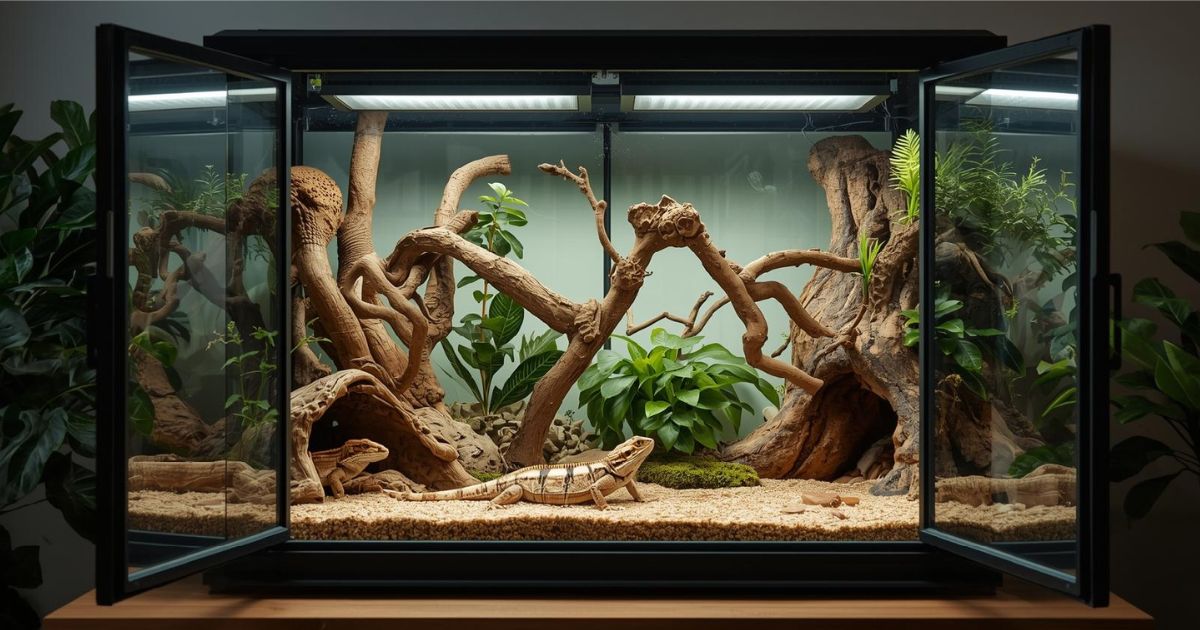
Complete Guide to Reptile Enclosures & Habitat Setup
Most reptile problems start long before the animal ever sees a vet or a medication bottle.
They start with the box you shoved it into and called a "home."
Pet stores sell glass coffins with a lizard sticker on the front and call them "starter kits." The internet backs them up with twenty conflicting care sheets written by people who once kept a gecko alive for nine months and decided they were an authority.
This guide is the antidote to that mess.
It walks through the part nobody wants to think about: building an enclosure that behaves like a life-support system instead of a decorative shoebox.
Step One: Pick the Right Cage, Not the Pretty One
Before you argue about bulbs, substrates, or "aesthetic," you need a box that isn't doomed from the moment you tape the receipt to the fridge.
Wrong enclosure means everything you stack on top of it is just expensive failure dressing.
Glass Tanks vs PVC vs Wooden Vivariums
Glass tanks are everywhere because they're cheap, stackable, and look great under bad pet store lighting.
They also bleed heat like a broken window and turn into humidity nightmares the moment you bring them into a real house.
PVC enclosures are the "boring black boxes" serious keepers hoard. They hold heat, don't rot, and don't care if the room humidity changes every time your radiator throws a tantrum.
Wooden vivariums sit in the middle: warmer than glass, fussier than PVC, and eventually warped by moisture when you pretend sealing is optional.
They can work beautifully, but only when you respect that wood is a sponge with opinions.
Here's the blunt version:
- Glass is fine for small, high-humidity or display setups if you're ready to fight evaporation and heat loss every day.
- PVC is the lazy person's smart choice for most snakes and lizards that need stable temps.
- Wood works when you seal it, ventilate it, and stop pretending your living room is a climate‑controlled lab.
Don't buy the box that looks best on Instagram.
Buy the one that makes it easiest to hit temperature and humidity targets without losing your mind.
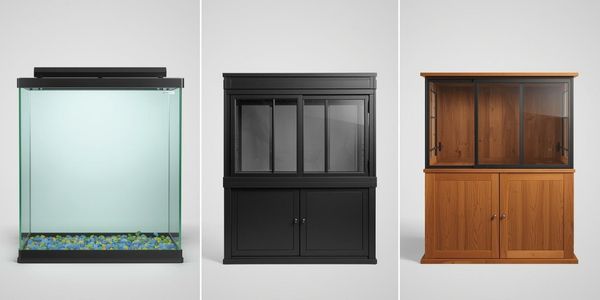
Most people waste money on glass tanks that bleed heat and require constant micromanagement.
The Carolina Custom Cages Terrarium (available in multiple sizes) uses PVC construction that holds temperature and humidity without fighting you every step of the way, front-opening doors, built-in ventilation, and actual insulation that makes thermostats work like they're supposed to.
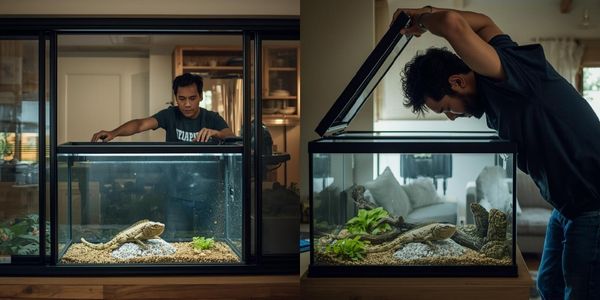
Front-Opening vs Top-Opening: Access Actually Matters
Grabbing an animal from above feels like being attacked by a sky‑predator.
Plenty of reptiles will tolerate it; almost none of them enjoy it.
Front‑opening doors turn routine maintenance into "slide, spot clean, refill, close" instead of "dislocate shoulder, move three lamps, swear, repeat."
They also make it far less likely you'll drop a hot fixture, a rock, or your phone into the tank while you're contorting over the rim.
Top‑opening tanks are fine for quarantine, tiny inverts, or things that don't care about being approached from above.
For everything else, front‑opening is the version that respects both your spine and the animal's nerves.
The Myth of the "Starter Kit"
Starter kits are designed to get money out of your wallet today, not keep your reptile alive five years from now.
They're under‑sized, under‑heated, under‑lit, and over‑priced bundles of compromise.
You usually get:
- A tank too small to last past adolescence.
- A combo dome that throws random heat and light without precision.
- A junk thermometer that lives on the wrong side of the glass like a decorative lie.
- Substrate the marketing team thought "looked natural."
By the time you've replaced everything that came in the kit, the only thing left is the glass box and a vague sense of regret.
Skip that whole arc and buy the pieces that work from the start.
Step Two: Size Isn't Optional, It's Oxygen
Reptiles don't stop needing space just because your apartment has opinions about square footage.
Cramped enclosures don't build "comfort." They build muscle loss, boredom, and a nervous system stuck on low‑grade panic.
General Size Rules That Don't Suck
You'll see people argue minimums like it's a sport, but there are some sane baselines.
These are not "go smaller when you feel like it" numbers. They are floors, not ceilings.
- Bearded dragon: 4x2x2 feet (around 120 gallons) for an adult. The 40‑gallon breeder is a cramped studio apartment, not a long‑term home.
- Leopard gecko: 36x18x18 inches or similar footprint. A plastic shoebox works for shipping, not for life.
- Ball python: Enough room to stretch out (4 feet for most adults) with actual clutter and hides, not a sterile drawer.
- Crested gecko: Tall, 18x18x24 inches minimum, with real climbing structure.
- Corn snake: 4 feet of floor space minimum, with vertical climbing options since they're semi‑arboreal.
Floor space matters more than gallons when you're dealing with terrestrial species.
Vertical height matters more than "how many liters" when the animal spends its life in trees.
The rule of thumb: the reptile should be able to move, thermoregulate, and hide without doing a three‑point turn every time it breathes.
Growing Room vs "I'll Upgrade Later"
"I'll upgrade when it gets bigger" is famous last budgeting.
Life happens, money slips somewhere else, and suddenly there's a four‑year‑old dragon still living in their childhood tank.
Buying the final‑size enclosure once costs more up front and less over the animal's lifetime.
It also removes the "I'll get to it" excuse that quietly turns into "never."
Young reptiles cope with big spaces just fine when you give them extra clutter and hides.
A giant bare box is stressful; a giant complex box is enrichment.
Step Three: Layout – Zones, Not Static Furniture
An enclosure isn't a diorama.
It's a set of zones the reptile uses like different rooms in a house: warm, cool, exposed, hidden, dry, humid.
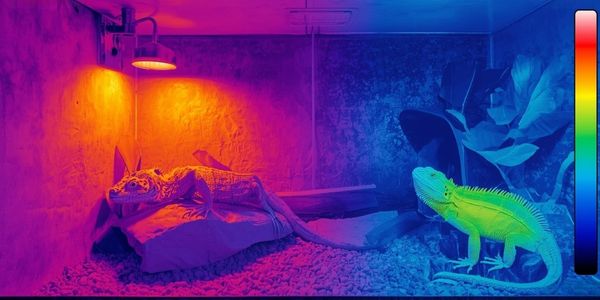
The Hot Side, Cool Side, and Middle Ground
You're not aiming for "the tank is 30°C."
You're aiming for "one end is hot enough to digest and the other isn't trying to bake organs."
- Hot side: Basking spot with a clear temperature target for the species.
- Cool side: A place to retreat where the animal won't slowly stew.
- Middle: The gradient in between, not just "the rest of the tank where nothing happens."
Place your heat source on one end, not the middle.
Point it at a basking surface, not at the animal's skull or the glass wall.
Clutter is Comfort, Not Mess
Minimalist setups are for humans who like clean lines, not for animals that evolved in environments where "line of sight" is broken every few steps.
Clutter gives reptiles choices: hide, climb, squeeze, overlook, retreat.
- Branches that actually support the animal's weight.
- Cork rounds and slabs to break sight lines and create tunnels.
- Rock stacks secured so they don't turn into gravestones.
- Plants (real or fake) that interrupt open space without falling over every time the animal moves.
You should be able to look into the enclosure and not immediately see the animal.
That doesn't mean it's gone. It means it finally has somewhere to exist without being on stage 24/7.
Hides: Panic Boxes vs Real Refuge
Those novelty skull caves with eyes big enough to land a drone through?
They're decoration, not security.
A proper hide is:
- Dark inside, even when lights are on.
- Snug enough that the animal's body touches at least two sides when it's tucked in.
- Accessible without the reptile having to parade across open ground first.
- Stable enough that it won't collapse, roll, or tip if the animal shifts.
You need at least two hides: one on the warm side, one on the cool side.
Those novelty skull hides with airplane-hangar openings aren't fooling anyone except the humans buying them.
Forcing a reptile to choose between "be the right temperature" and "feel safe" is how you create chronic stress that never announces itself until something breaks.
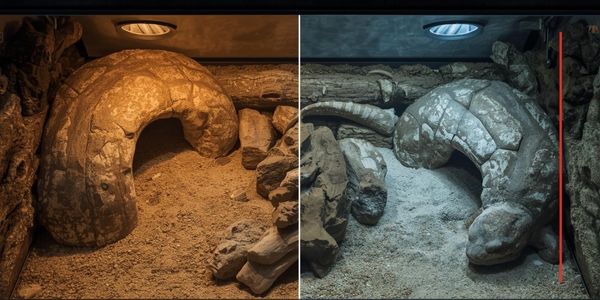
The Exo Terra Reptile Cave comes in small, medium, and large sizes with properly snug interiors, naturalistic textures for shedding assistance, and openings sized for security rather than Instagram aesthetics. Actually dark inside, stable enough not to tip, and available in designs that work for both desert and tropical setups.
Step Four: Substrate – What They Stand On Matters
Substrate isn't just flooring.
It's part of the humidity system, the waste management plan, and occasionally the thing that kills your reptile when they eat a mouthful during feeding.
Loose vs Solid Substrates
Loose substrates (sand, soil, bark, coconut fiber) look natural and let some species dig, burrow, or nest.
They also clog guts, harbor bacteria, stick to wet food, and become swamp mud when humidity spikes.
Solid substrates (tile, shelf liner, reptile carpet, paper towels) are easy to clean, impossible to ingest, and boring as hell to look at.
They also offer zero enrichment, no humidity buffer, and no chance for natural behaviors like digging.
Which one you use depends on:
- Species behavior (does it dig? burrow? need humidity?)
- Feeding method (tong-fed means less accidental substrate intake)
- Your commitment to spot-cleaning and full changes
- The reptile's health history (impaction-prone animals get solid floors)
There's no universal "best" substrate.
There's only "what works for this animal in this setup with this keeper's routine."
Burrowing species deserve actual enrichment, not a tile floor with participation-trophy decorations.
The Zoo Med Excavator Clay Substrate lets you sculpt tunnels, caves, and burrows that hold their shape when moistened and dry into stable structures that won't collapse mid-nap. Mix with sand for desert species or use alone for semi-arid setups. Actually allows natural digging behavior without the impaction lottery that comes with loose calcium sand.
Popular Substrates, Translated
Calcium sand: Marketed for desert species, notorious for impactions. Skip it unless you enjoy expensive vet x-rays.
Coconut fiber / coco coir: Holds humidity, looks decent, breaks down slowly. Works well for tropical and burrowing species when kept appropriately moist.
Cypress mulch: Good for moderate humidity setups, resists mold better than some alternatives, but can get moldy if you drown it.
Reptile carpet: Easy to clean, reusable, and about as enriching as a yoga mat. Fine for temporary setups or animals recovering from impaction.
Tile: Holds heat, easy to sanitize, lasts forever. Also cold, hard, and utterly soulless without additional enrichment.
Paper towels: The quarantine and hospital standard. Cheap, disposable, shows feces and parasites clearly. Not a long-term solution unless you've given up on aesthetics entirely.
Bioactive substrate mixes: Soil, sand, clay, leaf litter, isopods, springtails—the whole self-cleaning ecosystem thing. Works beautifully when dialed in; turns into a science project when it isn't.
Depth Matters
A thin sprinkle of substrate looks finished and does nothing.
Burrowing species need enough depth to actually burrow, 3 to 6 inches depending on size.
Non-burrowers just need enough to cover the floor and maybe hold a bit of humidity.
Too much substrate in a small enclosure eats floor space and makes a mess during feeding.
Too little and you're basically running a tile floor with decorative dust.
Step Five: Decorations That Actually Do Something
Decorations aren't there to make your tank look like a pet store window.
They're functional enrichment: climbing, hiding, basking, scratching, exploring.
Branches and Climbing Structure
Arboreal and semi-arboreal species need branches that support their weight without sagging or snapping.
Collect hardwood branches from pesticide-free areas, bake them at 200°F (93°C) for an hour to kill hitchhikers, then arrange them so the reptile can actually use them.
Grapevine, manzanita, and driftwood look good and last years.
Flimsy craft store twigs snap under a gecko's weight and become liability decorations.
Plastic decorations look finished in photos and do absolutely nothing for the animal living in the tank.
The Zoo Med Natural Cork Bark Rounds provide climbing structure, hiding spots, and textured surfaces for shedding, plus they're lightweight, rot-resistant, and safe if the reptile decides to explore with its mouth. Available in multiple sizes for everything from hatchling geckos to adult boas. The actual functional enrichment your enclosure is missing.
Rocks and Basking Platforms
Rocks hold heat and give basking species a stable surface to absorb warmth from below and above.
Slate works well. Sandstone crumbles. Anything sharp or unstable is a future vet visit.
Secure stacks with aquarium-safe silicone or build them directly on the tank floor so they can't topple and crush your animal.
Live Plants vs Fake Plants
Live plants look stunning, regulate humidity, and provide real cover.
They also die when you forget to water them, get trampled by large reptiles, and sometimes come with pesticide residue or fertilizer toxicity.
Fake plants don't die, don't need light, and stay exactly where you put them.
They also look fake under close inspection and need regular cleaning because dust and feces don't discriminate.
For bioactive setups, live plants are part of the ecosystem.
For low-maintenance or high-traffic enclosures, quality fake plants do the job without the guilt.
Step Six: Common Setup Failures
Most enclosure problems are predictable.
Here's what people screw up reliably and how to not join them.
No Temperature Gradient
Heat lamp in the middle, thermometer reading "warm enough," entire tank at one temperature.
The reptile has nowhere to cool down and nowhere to warm up.
That's not husbandry, that's slow-cooking with extra steps.
Hides Only on One Side
One hide on the warm side means the animal picks "safety" or "correct temperature," never both.
Two hides (minimum) mean they can be safe and thermoregulate properly.
Thermometer Placement Theatre
Sticking a thermometer to the outside glass or dangling it in midair tells you nothing useful about where the reptile actually lives.
Put probes at animal height: one on the basking surface, one on the cool side floor.
Overcrowding Decorations
Jamming every stick, rock, and plastic plant into the tank because "more enrichment" just creates an obstacle course.
Leave open pathways between zones so the animal can move without climbing a jungle gym every time it needs water.
Ignoring Ventilation
Glass tanks with solid lids become stagnant humidity traps.
Wooden vivariums with sealed vents grow mold colonies.
Ventilation isn't optional unless you enjoy respiratory infections and fungal blooms.
Step Seven: Setup Checklist Before the Animal Arrives
You should not bring the reptile home until every item on this list is installed, tested, and working correctly.
Guessing at temperature and humidity is how you spend months wondering why your reptile won't eat, shed properly, or act normal.
The REPTI ZOO Digital Thermometer Hygrometer Combo (2-pack) gives you accurate temp and humidity readings on a clear LCD display with suction cup mounting, one for the hot side, one for the cool side. Reads in Fahrenheit or Celsius, updates every 5 seconds, and costs less than one vet visit for a respiratory infection you could've prevented.
Pre-arrival checklist:
- Enclosure of appropriate size for adult animal (not "for now").
- Heat source installed and controlled by a thermostat.
- Digital thermometers on both hot and cool sides, reading stable temps for 48+ hours.
- UVB lighting set up at correct distance (for species that need it).
- Substrate chosen and laid at appropriate depth.
- Minimum two hides: one hot side, one cool side.
- Water dish large enough for the animal to soak if needed.
- Clutter and climbing structure arranged to break sightlines.
- Hygrometer reading humidity levels that match species requirements.
- All decorations secured (no collapsing rock piles).
- Ventilation confirmed functional.
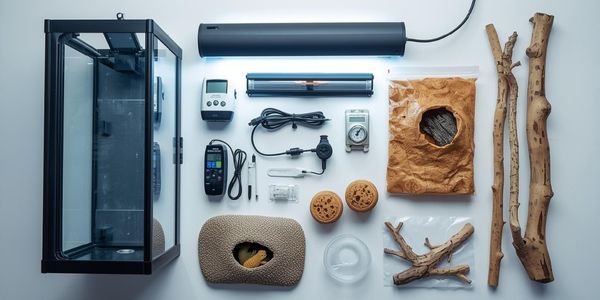
Run the setup empty for at least 48 hours to confirm temps and humidity stay stable.
Tweaking things after the animal arrives means the animal is your test subject, not your pet.
The Box Is the Foundation
Every health problem, feeding issue, and behavioral quirk you troubleshoot later will trace back to whether you got the enclosure right on day one.
Cheap out on the box, the layout, or the environmental controls, and you spend the next decade compensating for mistakes you could've avoided by doing it properly the first time.
The goal isn't a display tank that looks good on camera.
The goal is a life-support system that works even when you're not watching it.
🐾 Frequently Asked Questions
Q What's the best enclosure material: glass, PVC, or wood?
Depends on what you're keeping and how much you enjoy fighting physics. Glass looks nice, bleeds heat, and turns humidity control into a daily chore—fine for small tropical setups or display animals if you're committed to the maintenance. PVC is the boring workhorse that holds heat and humidity without drama, making it the smart choice for most snakes and desert lizards. Wood sits in the middle: better than glass for heat retention, worse than PVC for moisture resistance, and requires proper sealing unless you want warped panels and mold colonies. Pick based on your species' needs and your tolerance for temperature babysitting, not based on which one photographs better for Instagram.
Q How big should my reptile's enclosure actually be?
Bigger than the pet store told you, smaller than the "ethical keeper" gatekeepers demand, and ultimately based on the animal's actual behavior and needs. Bearded dragons need 4x2x2 feet minimum as adults, not the 40-gallon "starter" aquarium that turns into a lifetime sentence. Leopard geckos do fine in 36x18 inches of floor space with proper hides and clutter. Ball pythons need enough room to stretch fully plus actual environmental complexity, not a drawer with a water bowl. The rule isn't "biggest possible"—it's "big enough that the animal can thermoregulate, hide, move, and behave naturally without constantly navigating an obstacle course." Floor space matters more for terrestrial species; height matters more for climbers. If your reptile is pacing glass, refusing food, or camping in one spot forever, size might be your problem.
Q What substrate is safest for reptiles?
There's no universal "safe" substrate because it depends entirely on species, feeding method, and your willingness to maintain it properly. Loose substrates like coconut fiber work beautifully for tropical burrowers but become impaction hazards for clumsy feeders or animals with existing health issues. Tile and reptile carpet are impossible to ingest but offer zero enrichment and no humidity buffer. Paper towels are the hospital standard—cheap, disposable, shows health problems clearly, but they're boring and temporary. Calcium sand is marketed for desert reptiles and notorious for gut blockages; avoid it. Bioactive mixes with cleanup crews are ideal when dialed in correctly but turn into science experiments when they're not. Match substrate to behavior: diggers need depth, clumsy eaters need solid floors, humidity-dependent species need moisture-retaining options. The "safest" substrate is the one that fits your animal's needs while you actually maintain it.
Q Do I really need hides on both the hot and cool side?
Yes, unless you enjoy forcing your reptile to choose between feeling safe and being the correct temperature. A single hide means the animal either stays secure and suffers wrong temps, or sits exposed to thermoregulate while stressed. That's not a husbandry choice, that's low-grade torture you're normalizing because "it seems fine." Hides on both ends let the reptile be hidden while warm and hidden while cool, which is how they actually function in environments that didn't evolve to make them visible 24/7. The hide needs to be properly snug (body touching at least two sides), dark inside even with lights on, and stable enough that it won't collapse. Two hides minimum isn't perfectionism; it's basic functionality. If you're skipping this because "my reptile doesn't use hides," your reptile has learned that hiding isn't an option and is living in permanent low-grade stress mode.
Q Can I use a starter kit and upgrade later?
You can, but "later" has a funny way of turning into "never" once rent, car repairs, and life happen. Starter kits are designed to move product, not sustain life, they're undersized, under-equipped, and packed with components you'll replace within six months anyway. By the time you've bought the bigger tank, better lights, actual thermostats, and real hides, you've spent more than if you'd just done it right the first time. The "I'll upgrade when it grows" plan works in theory and fails in practice because animals grow faster than budgets recover. Young reptiles adapt fine to adult-sized enclosures when you add extra clutter and hides—big empty boxes stress them out, but big complex boxes are enrichment. Buy the final-size setup once, set it up correctly, and skip the guilt-upgrade cycle that quietly turns into "my four-year-old dragon still lives in a 40-gallon because I never got around to it."

📖 Related Articles
7 Ways to Socialize a Guinea Pig: The 2026 Guide

💬 Comments (0)
No comments yet. Be the first to share your thoughts! 👇
✍️ Leave a Reply