
5 Best Self-Cleaning Litter Boxes: Safety Features Compared
Last updated: October 12, 2026. This article is for general information and does not replace advice from your veterinarian. How we write our articles.
This post contains affiliate links. If you buy something through them, I earn a small commission at no extra cost to you. Details.
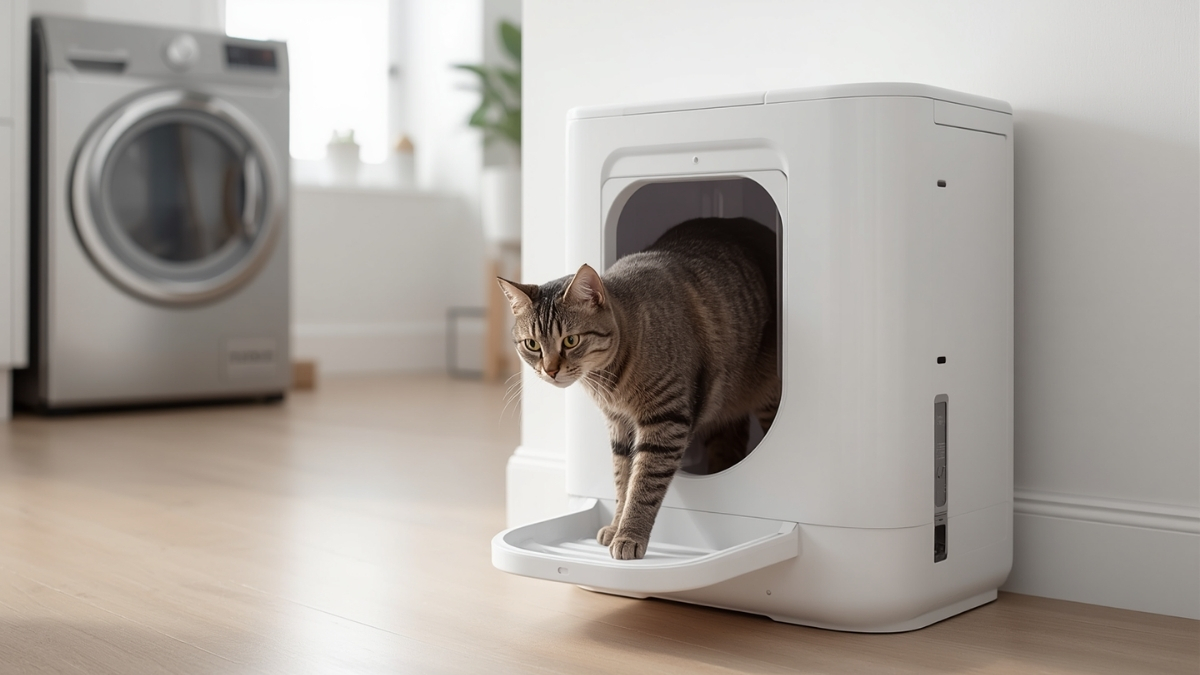
Quick Answer: The 5 Best Self-Cleaning Litter Boxes
- Safest design overall: Neakasa M1 Plus, an open-top box that never closes over your cat.
- Best all-rounder: PETKIT PuraMax 2, a best seller with an entrance that stays open during cleaning.
- Best for multi-cat health tracking: CATLINK Open-X, open-top, with separate pee and poop records for each cat.
- Best premium pick: PETKIT PUROBOT Ultra, with an AI camera and automatic bag sealing.
- Best if you never want to buy litter again: CatGenie A.I., which washes reusable granules and flushes the waste.
A self-cleaning litter box sounds like the perfect gadget: no more scooping, less smell, and a phone app that tells you when your cat used the box. For many households it works well. But these machines move while a cat may be nearby, they cost several hundred dollars, and not every cat accepts them.
This guide puts safety first. It explains what can go wrong with some designs, which cats should not use an automatic box at all, and how the five boxes below protect a cat that walks in during a cleaning cycle. Then it compares them on the points that matter in daily life: capacity, litter type, health tracking and running costs.

Are Self-Cleaning Litter Boxes Safe?
Well-designed models from established brands have several layers of protection, and most owners use them without any problem. The risk is real, though, and it is concentrated in a specific kind of design.
In 2024, a cat owner reported that her one-year-old Siamese cat died after its head got caught when a cheap automatic box sold on Amazon started its cleaning cycle. According to the report, the seller agreed to remove the product from Amazon as part of a settlement (Adopt a Pet, 2024). Similar look-alike boxes are sold under many brand names online. The same article warns that kittens can be too small or too light to trigger the sensors that stop a box mid-cycle.
Here is what to look for before you buy any automatic box:
- An entrance that never closes. On an open-top box, or on a drum that rotates sideways and keeps its opening clear, there is no point in the cycle where a cat can be shut in.
- Several kinds of sensors. Weight sensors notice a cat inside; infrared sensors notice a cat approaching. A good box uses both and pauses as soon as either one detects a cat.
- A delay before cleaning. The box should wait several minutes after your cat leaves, and start the countdown again if another cat comes in.
- A clear minimum age and weight. Most brands set a minimum of about 3.3 lb (1.5 kg) and, for several of them, an age of 6 months. Respect it.
- Up-to-date firmware. Connect the box to its app at setup and install any update, since sensor behavior is controlled by software.
No box is risk-free. Watch the first few cycles yourself, and never leave a kitten alone with an automatic box.
Who Should Not Use a Self-Cleaning Litter Box
- Kittens under 6 months, or any cat below the minimum weight in the listing. Use a regular box until they grow.
- Cats above the maximum weight. Many boxes stop at about 22 lb (10 kg). Large breeds need a model rated for their size.
- Very timid cats. Some cats refuse a box that hums, moves or smells new. An open-top model and a slow introduction help, but some cats never accept one.
- Owners who will stop looking at the litter. Scooping is also a daily health check. Changes in urine clumps or stools are often the first sign of illness, so if the machine does the work, use the app data and look at the waste drawer regularly.
How These Boxes Were Compared
These boxes were not tested on cats. They were compared from their Amazon listings, the manufacturers' published specifications and support pages, on the criteria below:
- Safety design: open top or closed drum, type of sensors, and whether the entrance stays open during a cycle.
- Cat size: the minimum and maximum weight in the listing.
- Capacity: waste bin size and how many days the brand says it lasts for one cat.
- Litter: which litter it accepts, since some boxes need a specific type.
- Health data: what the app records for each cat.
- Running costs: bags, filters, granules or cleaning solution you will keep buying.
All five are sold on Amazon at prices that change often, so prices are not listed here. Check the current price on each listing before you buy.
The 5 Best Self-Cleaning Litter Boxes
1. Neakasa M1 Plus: Safest Design Overall

Specifications (from the listing): Open top | Cats from 3.3 to 33 lb, up to 3 cats | Kitten Mode in the app for cats under 3.3 lb | 11.2 L waste bin, 7 to 14 days of use | 6-array rotary infrared system | 2.4 GHz Wi-Fi | 2-year protection plan
The M1 Plus has no hood and no closed drum. The litter bed tilts to sift the waste, and the listing says a gear structure limits how far it can rotate. Because the top is always open, there is no moment when a cat can be shut inside, which is the main reason it sits first on this list.
The open design also suits large cats and cats that dislike covered boxes. A brush strip seals the gap between the litter bed and the waste bin to keep smells in, and the app can tell several cats apart and log each cat's visits.
Pros:
- Open top: no enclosed space where a cat can be caught
- Widest weight range of the five, according to the listing
- One of the best sellers in its Amazon category, with thousands of reviews
Cons:
- Open design means more litter can be kicked out; a litter mat is included
- Wi-Fi works on 2.4 GHz only
- Several "M1" versions exist (M1, M1 Plus, M1 Lite): check that the listing is the Plus
Best for: Owners who want the lowest-risk design, large cats, and cats that refuse covered boxes.
2. PETKIT PuraMax 2: Best All-Rounder

Specifications (from the listing): 76 L interior | Cats from 3.3 to 22 lb, not for pets under 6 months | 7 infrared and 4 weight sensors | 7 L waste bin, up to 15 days | 7.87 inch low entry | Any clumping litter | 2.4 GHz Wi-Fi | 2-year warranty
The PuraMax 2 is one of the best sellers in its Amazon category, with thousands of reviews. According to the listing, the box pauses when its sensors detect a cat inside or approaching, and its anti-pinch structure keeps the entrance open at all times during cleaning.
It works with any clumping litter, which keeps running costs down, and the app records each cat's weight, number of visits and time spent in the box. The low entrance helps older cats with stiff joints. PETKIT warns not to put the box on a carpet or mat, which can disturb the sensors: place it on a flat, hard floor.
Pros:
- Entrance stays open during cleaning, with both infrared and weight sensors
- Works with any clumping litter
- Low entry for senior cats
Cons:
- Hooded design: shy cats may need a longer introduction
- Smaller waste bin than the premium models
- Must sit on a hard floor, not on a rug
Best for: Most households with one or two cats that want a proven automatic box without paying for a camera.
3. CATLINK Open-X: Best for Multi-Cat Health Tracking

Specifications (from the listing): Open top | Weight, infrared and anti-pinch sensors | Tells pee from poop for each cat | 12 L waste bin, up to 15 days for one cat | 2.4 and 5 GHz Wi-Fi | 1-year warranty
The Open-X is the second open-top box on this list. CATLINK says an incomplete gear design keeps the entrance open at all times, backed by weight sensors, infrared sensors and anti-pinch switches.
Its strength is health data in multi-cat homes. The app separates urination from defecation and gives daily and weekly reports for each cat. That matters because a change in how often a cat urinates is one of the early signs of urinary and kidney problems. One limit: the listing says cats need to differ by at least 0.9 lb (0.4 kg) for the box to tell them apart.
Pros:
- Open top with several types of sensors
- Separate pee and poop records for each cat
- Works on both 2.4 and 5 GHz Wi-Fi
Cons:
- Cannot tell apart cats of very similar weight
- Shorter warranty than the PETKIT and Neakasa boxes (1 year)
- The listing does not give a weight range: ask the seller if your cat is very small or very large
Best for: Multi-cat homes that want per-cat urine and stool records with an open-top design.
4. PETKIT PUROBOT Ultra: Best Premium Pick

Specifications (from the listing): AI camera with 210° view and cat face recognition | Automatic bag sealing and refill | 10 L waste bin, up to 20 days for one cat | Cats up to 22 lb | 2-year warranty
The PUROBOT Ultra is the most automated box in this guide. After each use it cleans the litter, and when the bin is full it seals the waste bag and loads a new one, so you never touch the waste. A camera recognizes each cat by its face and records visit times, duration, and photos of the stool and urine clumps.
PETKIT's Amazon listings for this model describe 20 sensors, a drum that stops as soon as a pet comes close, and a side-to-side rotation that keeps the entrance open at all times. Bundles with litter or extra bags also exist; the link above is for the box alone.
Think about privacy before you buy any litter box with a camera: it is an internet-connected camera in your home. Check the app's privacy settings, and know that some cloud video features may need a paid plan in the app.
Pros:
- Photos of each cat's waste make changes easier to notice and to show your vet
- Bags are sealed and replaced automatically
- Largest number of days between emptying in this guide
Cons:
- A premium price, and a large, heavy unit (46 lb, according to the listing)
- Camera in the home: a privacy trade-off
- Some cloud features may require a subscription
Best for: Owners who travel, multi-cat homes, and cats with a health condition that the vet wants monitored.
5. CatGenie A.I.: Best If You Never Want to Buy Litter Again

Specifications (from the listing and the CatGenie FAQ): Reusable washable granules | Waste liquefied and flushed | Bowl and granules washed and dried | Connects to a cold water line and drains into a toilet or laundry drain | Cats over 6 months | Best results with up to 2 cats of up to 20 lb each
The CatGenie works differently from every other box here. Instead of litter and a waste bin, it uses plastic granules that it washes and dries after each cleaning, while the waste is liquefied and flushed down a toilet or laundry drain. There is no bag to empty.
The trade-off is installation and consumables. The unit needs a cold water connection, a drain and a power outlet, although CatGenie says a plumber is not needed in most homes. It uses a SaniSolution cartridge, rated for about 120 cycles in standard modes, and the granules are topped up over time. According to the CatGenie FAQ, sensors keep the cycle from starting while a cat is in the bowl, and the unit waits after a visit before it cleans.
Pros:
- No litter to buy, carry or throw away
- No waste bin to empty
- No weight limit stated by the brand
Cons:
- Needs a water line and a drain nearby, which limits where it can go
- Ongoing cost of cartridges and granules
- Lower Amazon rating than the other four, so read recent reviews
Best for: Homes with a laundry room or bathroom spot near water, and owners who want to stop buying litter.
Comparison Table
| Box | Design | Cat size (listing) | Waste capacity | Health data | Warranty |
|---|---|---|---|---|---|
| Neakasa M1 Plus | Open top | 3.3 to 33 lb | 11.2 L, 7 to 14 days | Visits per cat | 2 years |
| PETKIT PuraMax 2 | Hooded drum, entrance always open | 3.3 to 22 lb, 6 months+ | 7 L, up to 15 days | Weight, visits, duration | 2 years |
| CATLINK Open-X | Open top | Not stated | 12 L, up to 15 days | Pee and poop per cat | 1 year |
| PETKIT PUROBOT Ultra | Drum with camera, entrance always open | Up to 22 lb | 10 L, up to 20 days, auto bagging | Camera, photos of waste | 2 years |
| CatGenie A.I. | Washing bowl | 6 months+, no weight limit | Flushed, no bin | App alerts and usage | See listing |
Capacity in days is the brand's figure for one cat. With two or three cats, expect to empty the bin about two or three times as often.
What Health Tracking Can and Cannot Tell You
A litter box sees things that owners easily miss. In a 2026 study of cats monitored by a smart litter box, cats with chronic kidney disease urinated more often, spent longer eliminating and covered their waste less than cats with no known condition, and a model built on these patterns told the two groups apart with high accuracy (Langenfeld-McCoy et al., 2026).
Keep the limits in mind. That study looked back at cats already diagnosed; it did not show that a smart box finds disease earlier or improves outcomes. It was also run by researchers from Nestlé Purina, which makes a litter box monitor. And each brand's app uses its own methods, which are not the ones from the study.
Use the data as an early warning, not as a diagnosis. If your cat's visits suddenly increase, or the app flags unusual changes, book a vet visit. If you care for a cat with kidney disease, our guide to caring for a senior cat with kidney disease explains what else to watch.
Emergency: a cat, especially a male, that strains in the box and produces little or no urine may have a urethral obstruction. Cornell University describes it as "an absolute emergency" that needs a vet right away (Cornell Feline Health Center). Do not wait for an app alert.
Hydration plays a big part in urinary health. See our cat hydration guide and our comparison of smart cat water fountains.
How to Introduce a Self-Cleaning Litter Box

- Keep the old box at first. Put the new box next to the old one, in the same quiet spot. Our guide to litter box placement mistakes explains where a box works best.
- Start with the power off, or in manual mode. Let your cat use it as a normal box for a few days, and run cleaning cycles only when your cat is in another room.
- Use the litter your cat knows, if the box accepts it. Some boxes need clumping litter; if your cat has asthma or a sensitive nose, our guide to low-dust litters for cats with asthma can help you choose.
- Switch on automatic mode once your cat uses the new box reliably, then remove the old box.
- Watch the first cycles and check that the box pauses when your cat comes close.
The AAHA/AAFP feline guidelines give a rule of thumb of one litter box per cat plus one extra (AAHA/AAFP, 2021). An automatic box can count as one of them, but in a multi-cat home it should not be the only box.
The Bottom Line
For most homes, the PETKIT PuraMax 2 offers a good balance of safety features, convenience and owner reviews. If safety is your first concern, or your cat is large or wary of covered boxes, choose the open-top Neakasa M1 Plus. For detailed health records in a multi-cat home, look at the CATLINK Open-X or, with a camera and automatic bagging, the PETKIT PUROBOT Ultra. And if you are done with litter altogether and have a water line nearby, the CatGenie A.I. is the only box here that uses none.
Whichever you choose, avoid cheap look-alike boxes with a door that closes during the cycle, respect the minimum age and weight, and keep looking at what your cat leaves behind.
Sources & References:
- Langenfeld-McCoy, N., et al. (2026). Enhancing Detection of Feline Chronic Kidney Disease Through Smart Litter Box Monitoring. Animals, 16(9), 1319.
- Cornell Feline Health Center. Feline Lower Urinary Tract Disease.
- AAHA/AAFP (2021). Feline Life Stage Guidelines: General Litter Box Considerations.
- Adopt a Pet (2024). A Woman Says an Automatic Litter Box Killed Her Cat.
- CatGenie. CatGenie A.I. Frequently Asked Questions.
Frequently Asked Questions
Are self-cleaning litter boxes safe for cats?
Well-designed models from established brands use weight and infrared sensors and pause when a cat comes close, and most owners use them without problems. The main risk comes from cheap enclosed boxes whose opening closes during the cycle: a cat death linked to one such box was reported in 2024. Choose an open-top box or one whose entrance stays open, respect the minimum age and weight, and never leave a kitten alone with an automatic box.
What is the safest self-cleaning litter box?
Open-top designs carry the lowest risk of a cat being caught, because there is no enclosed space that can close. In this guide, the Neakasa M1 Plus and the CATLINK Open-X are open-top. Among hooded drum models, look for an entrance that stays open during cleaning and for both weight and infrared sensors, as on the PETKIT PuraMax 2.
Can kittens use a self-cleaning litter box?
Most brands set a minimum weight of about 3.3 lb, and PETKIT and CatGenie do not recommend their boxes for cats under 6 months. Small kittens may be too light to trigger the sensors. Use a regular litter box until your kitten reaches the age and weight in the listing, unless the box has a dedicated kitten mode, and even then supervise.
Do self-cleaning litter boxes work with multiple cats?
Yes, most models in this guide are designed for two or more cats and can tell cats apart by weight or, on camera models, by face. The waste bin fills faster, so expect to empty it about two or three times as often as the brand's single-cat figure. Feline guidelines still recommend one litter box per cat plus one extra.
Can a self-cleaning litter box detect health problems?
It can flag changes, not diagnose them. A 2026 study found that cats with chronic kidney disease urinated more often and spent longer in the box than cats without a known condition. If the app shows a sudden change, see your vet. A cat that strains and produces little or no urine needs a vet immediately.
What litter do self-cleaning litter boxes need?
Most drum and open-top models work with clumping litter, and some work best with a specific type, so check the listing. The CatGenie is different: it uses reusable washable granules and a cleaning solution instead of litter. Low-dust litter is a good choice for cats with asthma.

Related Articles
Cat Zoomies: Why Cats Go Crazy at Night and After Pooping (and When It's Not Normal)
Cat zoomies explained: why cats race around at night and after the litter box, a timing decoder to read your own cat, the warning signs that need a …

4 Best GPS Trackers for Dogs: Escape Alerts Compared
The 4 best GPS trackers for dogs compared on escape alert speed, battery life, 3-year subscription cost and waterproofing, from Tractive to Dogtra and AirTag.

The Truth About Whisker Fatigue: Myths, Facts & Solutions
What the research really says about whisker fatigue, why your cat's bowl is rarely the real problem, and when to check the teeth instead.
How to Transition Your Cat to a New Diet Safely
How to transition your cat to a new diet: a 10-day mixing plan, tricks for picky eaters, the danger of a cat that stops eating, and when to …

8 Reasons Your Indoor Cat Is Stressed (and How to Help)
8 common reasons indoor cats get stressed, from boredom to hidden pain, and practical ways to fix each one.

5 Best Low-Dust Litters for Cats with Asthma
5 low-dust, unscented litters for cats with asthma, compared from their listings, plus litter box habits that cut dust and ammonia. See your vet first.
Comments (0)
No comments yet. Be the first to share your thoughts!
Leave a Reply