Best Cat Carriers for Anxious Cats: 6 Picks That Make Vet Visits Easier (2026)
📋 This post contains affiliate links. If you buy something through them, I earn a small commission at no extra cost to you. Details.
🩺 Last updated: October 4, 2026. This article is for general information and does not replace advice from your veterinarian. How we write our articles.

You pull the carrier out of the closet, and before it even touches the floor, your cat is gone. Under the bed, behind the washing machine, somewhere you did not know existed. Twenty minutes later you are late for the vet, your arms are scratched, and everyone in the house is stressed.
If that sounds familiar, the problem is rarely your cat being "difficult." Most of the time, it is the carrier itself and everything your cat has learned to associate with it. The good news is that both can be fixed. The right carrier makes loading, travel, and the exam itself far less frightening, and a few weeks of simple training can change how your cat feels about the whole thing.
This guide covers what actually makes a carrier work for a nervous cat, the best cat carriers for anxious cats available on Amazon right now, and a step-by-step plan to turn the box your cat dreads into a place they are willing to walk into.
Why Anxious Cats Hate Their Carriers
Cats are both predators and prey. In the wild, being trapped in a small space with no escape route is genuinely dangerous, so the instinct to avoid it runs deep. A carrier that appears only once a year, smells like the closet, and always ends at a clinic full of strange animals and alcohol wipes becomes a very clear warning sign.
Several things make it worse:
- Predictive cues. Cats learn patterns quickly. If the carrier only comes out before the vet, the sight of it alone can trigger panic.
- Unfamiliar smells. Scent is how cats judge safety. A carrier that smells of plastic, dust, or another animal feels hostile.
- Loss of control. Being lifted, pushed through a small door, and pulled back out by the legs is frightening for any cat, and especially for shy or older ones.
- Motion and noise. A carrier that slides around, rattles, or swings on a handle adds physical stress to emotional stress.
Fear also looks different from cat to cat. Some hiss and fight, while others freeze and go completely silent. If you are not sure how stressed your cat really is, our guide to reading cat body language explains the subtle signals, from flattened ears to a tucked tail.
What Makes a Carrier Anxiety-Friendly?
Feline behavior specialists and the AAFP and ISFM Cat Friendly guidelines agree on a handful of features that make visits calmer. Keep these in mind before you buy anything.
1. A top opening, or a top that comes off completely
This is the single most useful feature. Lowering a cat in from above is far easier than pushing them through a front door, and a removable top means a vet can often examine your cat while they stay in the bottom half, which feels much safer to them.
2. The right size
A good rule is a carrier about one and a half times the length of your cat. Too small feels cramped, but too big lets a frightened cat slide around during the drive. Your cat should be able to stand, turn around, and lie down comfortably.
3. Stability
Hard carriers with flat, non-slip floors, or soft carriers with a firm base, keep your cat from rolling around. A strap or loop that lets you buckle the carrier into a seatbelt is a big plus.
4. Easy to cover
Many cats calm down noticeably when they cannot see what is going on. A carrier you can drape a towel over, or one with roll-down flaps, gives them a hiding place on the move.
5. Easy to clean
Nervous cats sometimes have accidents. A wipeable shell or a removable, washable pad saves you a lot of trouble, and removes the smells that could make the next trip worse.
The 6 Best Cat Carriers for Anxious Cats (2026)
The carriers below were selected based on their design, materials, the features listed above, and their long track record with cat owners. Each one solves a slightly different problem, so read the "best for" line before choosing.
1. Catit Cabrio Cat Carrier: Best Overall for Vet Visits

→ Check Price & Reviews on Amazon
The Cabrio was designed around the idea that a cat should never have to be dragged out of a box. It opens from the top, the front, and the sides, so you can lift your cat straight in, and a vet can examine them without tipping them out. A single-hand locking system keeps it secure, the floor is skid resistant, and it can be belted into a car seat.
When it is not being used for travel, the top comes off and the base works as a bed, which is exactly what you want for carrier training: the carrier becomes furniture instead of a warning sign.
- Best for: cats up to 25 lbs who fight being pushed through a front door.
- Pros: 360° access, converts to a bed, seatbelt compatible, good ventilation.
- Cons: the latches take a little practice, and it is bulkier to store than a soft carrier.
2. Petmate Two Door Top Load Kennel: Best Budget Hard Carrier

→ Check Price & Reviews on Amazon
This is the classic plastic kennel many vets quietly recommend, and for good reason. It has a front door and a top door, so you can lower your cat in from above, and the two halves unscrew so the top can be removed at the clinic. It is sturdy, easy to wipe down, and inexpensive.
- Best for: owners who want a reliable, no-fuss carrier without spending much.
- Pros: top loading, removable top, durable, easy to clean, several sizes.
- Cons: it is plain and rigid, so add a soft towel or a pad that smells like home.
3. SportPet Large Hard-Sided Cat Carrier: Best for Large Cats

→ Check Price & Reviews on Amazon
Big cats often hate standard carriers simply because they barely fit. The SportPet uses a very wide side door, so a large cat can walk in naturally instead of being folded through a small opening. It comes with a removable, machine-washable bed and folds flat for storage between trips.
- Best for: Maine Coons, large mixed breeds, and cats up to 25 lbs.
- Pros: wide walk-in door, bed included, folds flat, roomy interior.
- Cons: no top door, so it suits cats that can be encouraged to walk in.
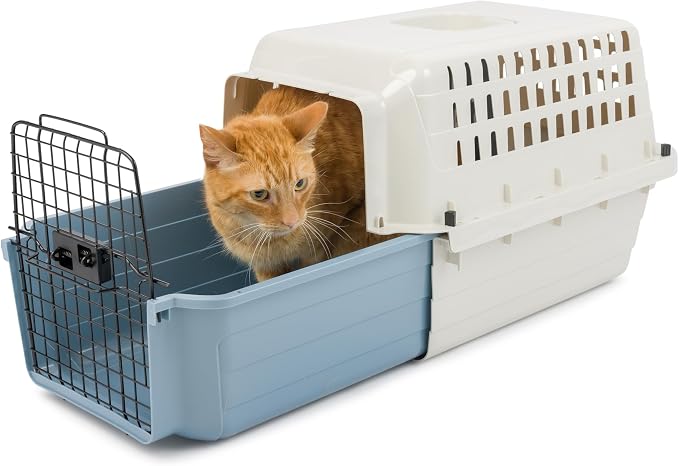
4. Van Ness Calm Carrier: Best for Cats Who Fight Loading
→ Check Price & Reviews on Amazon
This carrier takes a different approach. The floor is a sliding drawer: you pull it out, place your cat on it like a tray, and gently slide it back in. There is no pushing through a door, and getting your cat out at the clinic works the same way.
Reviews are more mixed than for the other picks, mostly about the plastic feeling lighter than expected. But for a cat that braces all four legs against any door, the drawer design can be a game changer.
- Best for: cats up to 20 lbs who spread their legs and refuse to enter.
- Pros: unique sliding drawer, good ventilation on all sides, tool-free assembly.
- Cons: mixed reviews on durability, and it costs more than a basic kennel.
5. Sherpa Original Deluxe Pet Carrier: Best Soft Carrier for Travel

→ Check Price & Reviews on Amazon
If your trips include flights or long days out, a soft carrier is lighter and more comfortable to carry. The Sherpa is one of the best known in-cabin carriers, with top and side zippered entries, escape-proof locking zippers, a waterproof base, and a washable faux lambskin liner. A luggage strap doubles as a seatbelt loop.
- Best for: air travel, and cats up to 16 lbs (Medium size) who feel safer in a softer, darker space.
- Pros: top entry, airline approved, comfortable shoulder strap, washable liner.
- Cons: less protective than a hard shell, and determined cats can push on mesh panels.
6. Amazon Basics Soft-Sided Pet Carrier: Best Budget Soft Option

→ Check Price & Reviews on Amazon
A simple, affordable soft carrier with both front and top zippered openings, mesh ventilation, and a removable fleece pad you can toss in the wash. It fits under most airline seats and works well as a secondary carrier, or as a first carrier for a cat who has never traveled.
- Best for: tight budgets and occasional vet trips.
- Pros: top and front loading, washable pad, lightweight, airline friendly size.
- Cons: basic materials, not ideal for cats who claw at mesh.
Quick Comparison
| Carrier | Loading | Max Weight | Best For |
|---|---|---|---|
| Catit Cabrio | Top, front and sides | 25 lbs | Vet visits |
| Petmate Two Door Top Load | Top and front | Varies by size | Budget |
| SportPet Large | Wide side door | 25 lbs | Large cats |
| Van Ness Calm Carrier | Sliding drawer | 20 lbs | Cats who fight loading |
| Sherpa Original Deluxe (M) | Top and side, soft | 16 lbs | Air travel |
| Amazon Basics Soft-Sided | Top and front, soft | 22 lbs | Budget soft option |
How to Carrier-Train an Anxious Cat
Even the best carrier will not help much if it still means "vet." Carrier training changes that association, and it works. In a study from the University of Veterinary Medicine in Vienna, cats trained with positive reinforcement were less stressed during the car journey, and their veterinary exams could be completed more quickly.
Plan for two to three weeks of short, relaxed sessions. Never rush a step.
- Make the carrier furniture. Leave it open in a room your cat likes, with a soft blanket that smells of your home. Remove the top or door if you can.
- Add good things. Toss treats near the carrier, then just inside, then at the back. Feed meals beside it, then inside it.
- Reward calm visits. Whenever your cat chooses to sit or nap inside, quietly drop a treat in. No closing, no touching.
- Put the top back on. Once your cat walks in happily, reassemble the carrier and keep rewarding.
- Close the door briefly. Shut it for a few seconds while your cat eats, then open it. Slowly build up to a minute or two.
- Lift and move. Lift the carrier an inch, set it down, reward. Then carry it around the room, then to the car.
- Short drives. Take a two-minute drive around the block and come home to treats. Repeat until it feels routine.
If your cat shows signs of stress at any step, such as crouching, wide pupils, or trying to leave, go back to the previous step for a few days. For more ideas on keeping road trips calm, see our cat travel tips to reduce stress.
Your Vet Day Game Plan
A little preparation on the day makes a big difference.
- Bring the carrier out early. If it has been living out as furniture, this step is already done.
- Use a calming pheromone. Synthetic feline facial pheromones mimic the scent cats leave when they rub their cheeks on things they consider safe. Spray the carrier bedding about 15 minutes before your cat goes in, never directly on your cat.
- Cover the carrier. A light towel over the top blocks scary sights in the car and the waiting room.
- Carry it with two hands. Hold it against your body like a box, not swinging from the handle.
- Belt it in. Place the carrier on the back seat floor or belt it in, so it does not slide.
- Keep the waiting room short. Ask if you can wait in the car or an exam room, away from barking dogs. Many clinics with Cat Friendly certification have cat-only waiting areas.
- Ask about food. Some vets suggest skipping a meal before travel to reduce nausea and make treats more motivating at the clinic. Always check with your vet first, especially for kittens, seniors, or cats with medical conditions.

The most widely used pheromone spray is FELIWAY Classic Calming Spray. One bottle lasts for dozens of uses, and the effect on bedding lasts a few hours, which covers most vet trips.
→ Check Price & Reviews on Amazon
When Carrier Anxiety Needs Your Vet's Help
For most cats, a better carrier and some patient training are enough. But some cats panic so badly that they hurt themselves, drool heavily, vomit, or become aggressive at every visit. That level of fear is a welfare problem in itself, and it also makes proper examinations harder.
If that sounds like your cat, talk to your veterinarian before the next appointment. They can suggest a plan built around your cat, which may include home visits, a different appointment time, or medication prescribed specifically for travel. The American Animal Hospital Association also has useful guidance on helping cats cope with vet visits.
It also helps to know your cat's normal behavior. A cat that suddenly hides more than usual, or stops coming out at all, may be unwell rather than simply nervous. Our guide on when cat hiding behavior is a reason to worry walks through the warning signs. And if your cat seems tense at home too, these common causes of stress in indoor cats are worth a look.
The Bottom Line
An anxious cat is not being stubborn. They are reacting to an experience that, from their point of view, makes complete sense to fear. A carrier that opens from the top, stays stable, and can double as a bed takes away most of the struggle, and a few weeks of training can take away much of the fear.
For most owners, the Catit Cabrio or the Petmate Two Door Top Load is the best place to start. Leave it out, fill it with treats and a familiar blanket, and let your cat discover it on their own terms. The next vet visit may surprise you both.
Sources & References
- Rodan I, Dowgray N, Carney HC, et al. 2022 AAFP/ISFM Cat Friendly Veterinary Interaction Guidelines: Approach and Handling Techniques. Journal of Feline Medicine and Surgery.
- Pratsch L, Mohr N, Palme R, et al. Carrier training cats reduces stress on transport to a veterinary practice. Applied Animal Behaviour Science, 2018. Summary: dvm360.
- American Animal Hospital Association. Helping your cat cope with veterinary visits.
🐾 Frequently Asked Questions
Q What type of carrier is best for an anxious cat?
A sturdy carrier that opens from the top, or whose top half can be removed completely, is usually best. It lets you lower your cat in instead of pushing them through a door, and many vets can examine the cat while it stays in the bottom half, which feels much safer.
Q Should I cover my cat's carrier during travel?
Yes, for most nervous cats. Draping a light towel over the carrier blocks frightening sights in the car and the waiting room. Leave the front or a side partly uncovered so air can circulate, and check on your cat regularly.
Q How long does carrier training take?
Most cats need two to three weeks of short, relaxed daily sessions. Very fearful cats may need longer. The key is to move to the next step only when your cat is calm and comfortable with the current one.
Q Is a hard or soft carrier better for a scared cat?
Hard carriers are more stable and protective, and the best ones open from the top, which makes them ideal for vet visits. Soft carriers are lighter and great for flights, but they offer less protection. Many owners keep a hard carrier for the vet and a soft one for air travel.
Q How do I get a scared cat into a carrier without a fight?
Bring the carrier out well before the trip, stand it on its end with the opening facing up, and lower your cat in gently, back legs first. Wrapping your cat loosely in a towel can help. Over time, carrier training with treats removes most of the struggle.

📖 Related Articles

8 Subtle Signs Your Cat Loves You (Even When They Act Like You're Invisible)
The 3 AM Scream: Why Do Cats Meow So Much at Night (And How to Save Your Sanity)

8 Reasons Why Your Indoor Cat Is Stressed, Is Your Home a Prison?

7 Activities to keep your cat mentally stimulated

10 Cat Travel Tips to Reduce Stress (That Actually Work)
💬 Comments (0)
No comments yet. Be the first to share your thoughts! 👇
✍️ Leave a Reply